Photographing Pilatus – One of the Best Viewpoints and Subject in the Central Switzerland

Pilatus is not some unconquered summit or the dream of serious alpinists. At 2128.5 meters above sea level, it is hardly an impressive height by Alpine standards. And yet, almost everyone in Switzerland has heard of Pilatus. It has become one of those classic stops on a trip that includes Lucerne and almost anything else in the country. So what makes this mountain so special? The answer is simple: the views.

I will not pretend otherwise. Pilatus is a mountain either for the lazy or for the ambitious. There is not much in between. Let me start with the first group because, to be honest, we still have not hiked all the way up, even though we have already been there five times.
To reach the top of the massif, and Pilatus is a massif, with Tomlishorn as its highest point, all you need to do is board a cable car or train and step out at the top. And to make it even easier, there are two ways to get there. You can take the cable car from Kriens above
Lucerne, or the cogwheel railway from Alpnachstad. Both routes meet at a central station near the summit, a place that feels a bit like an airport lounge. Pilatus became so popular that the Swiss eventually added another means of transport to ease the pressure on the modest and slow carriages of the famously steep cogwheel railway.

The railway ride may be more romantic and probably more fun for children, but the gondola is the more practical option. There tend to be fewer crowds, parking is usually easier, and the views on the way up are excellent. Families with younger children may also appreciate Fräkmüntegg, the middle station, where there is a large playground, a ropes park, and places to barbecue. The trains run regularly, but it is often busy.
Once the ticket is scanned and the doors close, the ascent begins. About half an hour later, you arrive at Pilatus. At the top, you are welcomed by exactly what you might expect in Switzerland: souvenir shops, buffet-style food, and carefully polished infrastructure. There is also a proper hotel here, Pilatus Kulm Hotel, with a large bar and an elegant restaurant. So you can either sit down for a more refined meal in a grand interior that still carries some Belle Époque atmosphere, or simply grab something casual and stretch out on a deckchair with a beer.


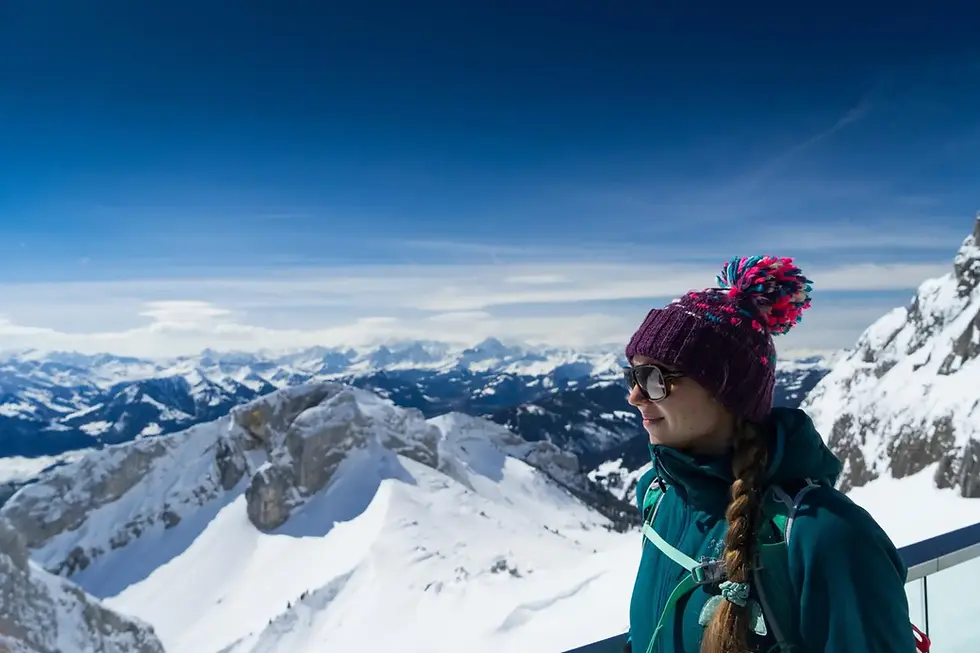

Yes, deckchairs. On sunny days, the atmosphere on Pilatus can feel almost like a mountain beach. They are popular all year round. Especially when low clouds cover the lower elevations, Pilatus becomes a natural retreat for sunlight and wide Alpine views. On such days, I suspect it is also hardest to find parking down below.
Still, you should earn that relaxation with at least a little walking. From the summit area, two nearby peaks, Esel and Oberhaupt, are within easy reach and take only a few minutes to access. If you want a slightly longer outing, there is also a gentle and well-maintained path leading to Tomlishorn, the highest point of the massif. It takes around an hour and involves only about 150 meters of ascent, so it hardly feels like a major effort. Beneath the northern summit of Oberhaupt, there are also tunnels with viewing windows looking out toward Lucerne and the canton of Aargau. After all that exertion, the deckchair and beer feel completely justified.
And the views really are superb. On a clear day, you can see the highest peaks of the Bernese Oberland and the Uri Alps. Toward the south-eastern side, the silhouettes of Rigi and Alpstein appear. In the foreground, of course, lies the striking shape of Lake Lucerne, with Lake Zug visible farther away.
So why is Pilatus called Pilatus? One legend claims that Pontius Pilate spent the end of his life here and that the mountain took its name from him. There are, of course, many legends about Pilate, and several places claim some connection to his life or death. Still, only one mountain carries his name. How much of that is fact and how much is legend is another matter entirely.

Hiking up Pilatus
Although the mountain is not especially high, the ascent is not exactly casual if you start from the bottom. From the parking area in Alpnachstad, you are looking at 1600 meters of elevation gain and around four and a half hours of steep uphill hiking one way. Since more than half of that route runs through forest, it does not strike me as the most appealing option.
A better alternative is to take the cogwheel railway up to Aemsigen and start walking from there. That way, you begin above the tree line, and the remaining climb is about 720 meters with a hiking time of roughly two hours.

There is also another route that seems more attractive. It begins in Lütholdsmatt, where there is a small parking area reached by a very narrow and winding road. From there, you can follow scenic route number 57 on the ascent and return via Tomlishorn and the ridge toward Wilderfeld. The elevation gain from the trailhead to the summit is around 1200 meters, and the full loop should take about six hours for 14 kilometers. It is, however, a route for summer and autumn only.
And once you have reached Pilatus, whether by train, cable car, or on foot, you can always head down afterward and spend a little time in Lucerne with a coffee and some time by the lake.
Photographing Pilatus
Pilatus is not only a rewarding viewpoint. It is also a fantastic subject to photograph from elsewhere around Lake Lucerne. Seen from places such as Weggis and Vitznau, the massif rises with a strong, recognizable shape above the water and often becomes one of the defining elements of the landscape. From these eastern shores of the lake, Pilatus feels broader and more sculptural than it does from Lucerne itself, especially when changing weather adds layers of atmosphere around the ridges.
It works particularly well in the early morning or late evening, when the light moves softly across the slopes and the lake reflects the sky. On calm days, the combination of water, distant mountain forms, and lakeside foregrounds can create elegant and balanced compositions. In moodier weather, Pilatus becomes even more photogenic. Low clouds, mist above the lake, and shifting rain bands often give the mountain a dramatic presence that feels far more alpine than its altitude might suggest.

Weggis and Vitznau are also useful because they offer different photographic interpretations of the same massif. In one place, Pilatus can appear as a dark, compact wall behind the lake. In another, it opens into a wider sequence of ridges and slopes. That makes it a subject worth returning to repeatedly, especially in different seasons. Autumn haze, winter clarity, spring clouds, and summer storms all change its character completely.


Things to do in Lombok discussions usually focus on coastal scenery, but seasonal wind patterns could affect activity choices across different months. Certain areas appear more suitable during specific periods. A few comparative materials touch on this aspect, though the criteria behind those variations are not fully explained.